
Experience Articles
Choosing "India" on Purpose — Discovering Myself as a Japanese through Research and Daily Life.
In February 2025, Mr. TANABU Tomoya, then about to enter his fourth undergraduate year in the Faculty of Engineering at the University of Tokyo, spent one month at the Indian Institute of Technology Hyderabad (IITH), conducting IT-related research together with IITH graduate students. The experiences he gained in a research environment, culture, and daily life so different from Japan significantly transformed his values.
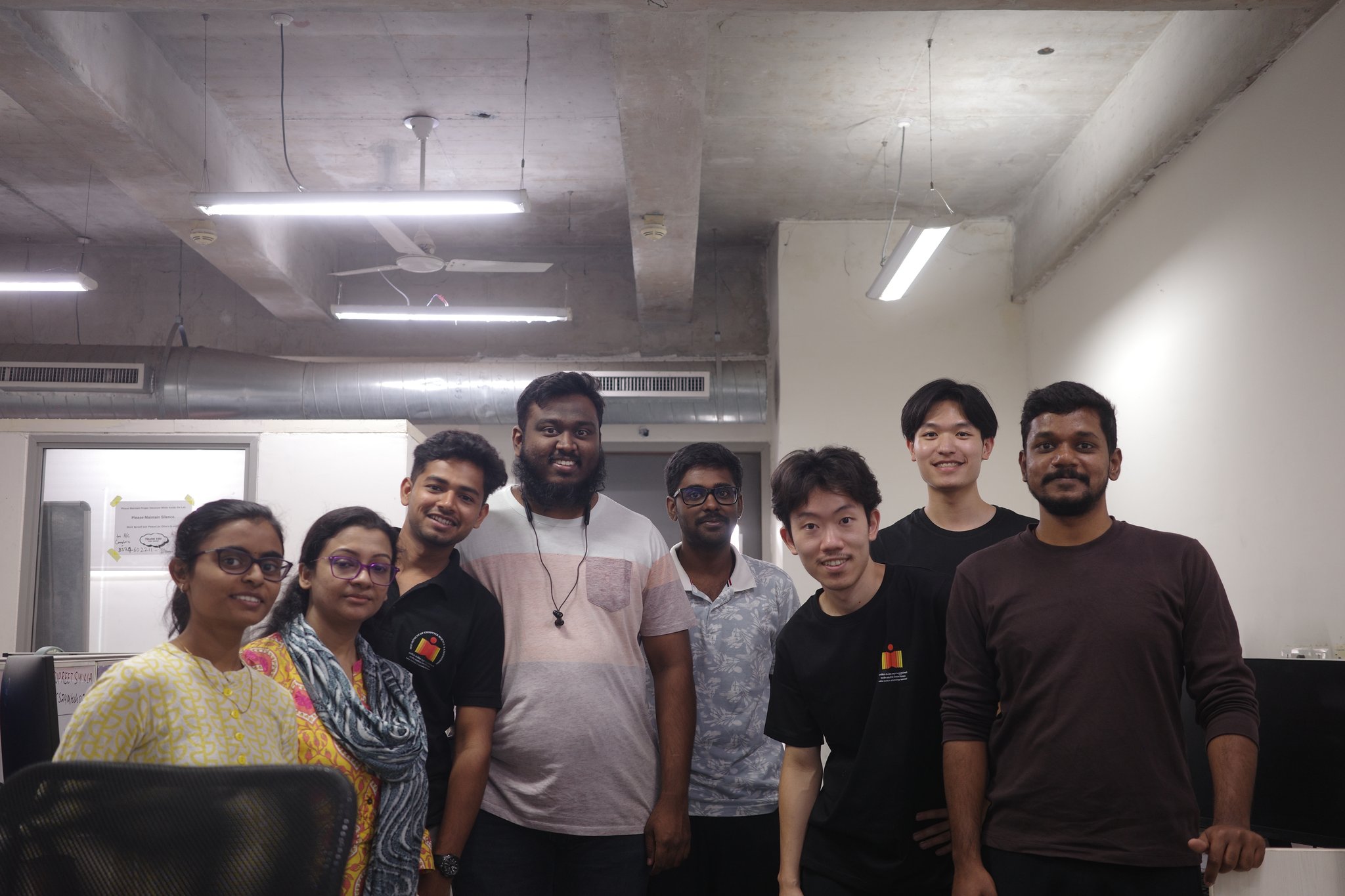
With fellow research interns at IITH Prof. Kataoka's laboratory (Mr. TANABU: second from the right)
“Why India? Why IITH?” — I wanted to see and find out for myself
As he was about to submit his choice of laboratory placement for his fourth undergraduate year, he wanted to experience firsthand what “research” really means. Around that time, he came across the “Research Internship Program at IITH,” which his university was promoting. There were opportunities to experience research in places other than India, but having previously lived in Europe and North America, he intentionally chose India.
“I had never been to India before. What I knew came only from books or media. But instead of such second-hand information, I wanted to see with my own eyes: What is the real India like? While living abroad, I had opportunities to interact with Indian people - they were brilliant, determined, and left a strong impression on me. I kept wondering: what is their homeland, India, really like? So I wanted to go to a local university, engage directly with its culture, and see their values firsthand.”
Although the program was primarily designed for research, the decisive factor for him was this desire to experience India directly.
Beginning Research Life in a Different Culture — Realizing that “nothing starts if I stay silent”
Together with IITH graduate students, he worked on research concerning Software Defined Networks (a technology to virtually build computer networks through software). However, there were no detailed instructions or clear schedules as he might have expected.
“At first, I was puzzled. No one told me, ‘From here, do this.’ But after a week, I realized that nothing would move forward if I stayed silent. If I had questions, I had to go ask. If you remain passive, nobody is going to step in to help you. So the most important thing is to move on your own initiative. That’s what I really felt at that time.”
What research taught him was the importance of proactiveness. It was not about someone showing a clear path, but about exploring one’s way forward and finding direction. This lesson in self-driven inquiry has continued to shape his approach even after returning to Japan and joining his assigned laboratory.
Dormitory Life and Newfound Confidence — Inspired by the Passion of IITH Students
During his stay at IITH, he lived in the university dormitory, sharing the cafeteria and daily routines with IITH students. The facilities and environment were very different from Japan, and he was particularly surprised by the showers, where swarms of mosquitoes gathered at night, making bathing a struggle.
“Since I wanted to interact with Indian students, I think it was good that I lived in the student dormitory, even with the inconveniences. And the fact that I was able to live in that environment for one month has become a source of confidence. Now I feel like I can go anywhere in the world.”
What also impressed him through his interactions on campus was the intensity of IITH students’ enthusiasm for research and learning. They were already thinking seriously about how to use their current studies and research at IITH as a foundation to take further steps in their careers. He was also impressed by the high number of female students at the institute, despite it being a science and engineering university.

With fellow research interns at the Holi festival on campus (Mr. TANABU: the front left)
Discovering Japan’s Strengths and Awakening to My Identity as Japanese
“In Japan, stable Wi-Fi, safe tap water, and clean streets are all taken for granted. But being in India made me realize just how precious such infrastructure really is. Until now, I had dreamed of working overseas, but this experience gave me a new desire: to contribute to Japan, which is so fortunate to have these conditions. What I thought was ‘normal’ is not normal at all.”
He had previously lived in Europe and North America. In those multicultural societies, people of diverse backgrounds coexist, and he felt, “I am just one among many.” But in India, the situation was entirely different.
“In Europe or North America, I rarely thought about being Asian or Japanese. The surroundings were diverse, and I didn’t particularly stand out. But in India, both on campus and in the streets, the overwhelming majority were Indian, so as a foreigner I stood out clearly. Just walking down the street drew attention or prompted people to talk to me.”
Through such experiences, he became much more strongly aware of his identity as Japanese.
A Message to Japanese Students — “If You’re Hesitating, Just Go”
To fellow Japanese university students who may be considering studying at an Indian university, he gives this message:
“If you are hesitating, I strongly encourage you to go. You’ll meet students who devote themselves passionately to research and study for their future career, and people who strive to live earnestly even under limited infrastructure. Experiencing such multi- layered realities of India — which cannot be seen through tourism — will surely become an irreplaceable experience that you could never gain by staying only in Japan.”